Best Filament for Outdoor Use: ASA vs PETG vs PLA
ASA is the best filament for parts that live outside, because it shrugs off sun and heat. If your printer has no enclosure, PETG is the easy, almost-as-good choice. Avoid plain PLA for anything in direct sun.

Quick answer: For years in the sun, print in ASA. For an open printer, print in PETG. For flexible outdoor parts, use TPU. Keep PLA indoors.
What outdoor parts have to survive
- UV light: sunlight breaks down many plastics. They fade, chalk and turn brittle.
- Heat: a dark part in direct summer sun can get much hotter than the air around it.
- Water and frost: rain, sprinklers and freezing water in small gaps.
- Load over time: a bracket that holds weight for months can slowly bend, especially when warm.
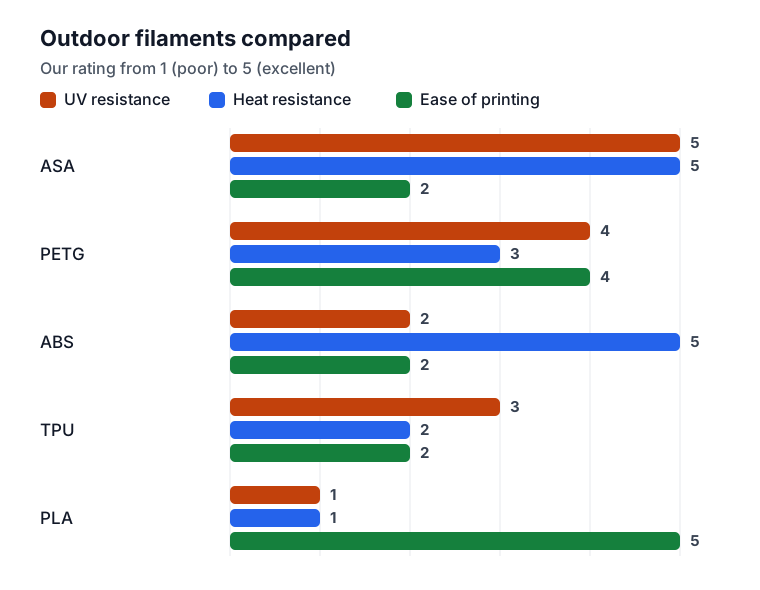
Outdoor filaments compared
| Filament | UV resistance | Softens at about | Enclosure | Best for |
|---|---|---|---|---|
| ASA | Excellent | 90–100 °C | Needed | Parts that stay outside for years |
| PETG | Good | 75–80 °C | Not needed | Garden, balcony and car parts on an open printer |
| ABS | Poor without paint | 95–105 °C | Needed | Hot places out of direct sun |
| TPU | Fair to good | Flexible | Not needed | Bumpers, seals, feet and grips |
| PLA | Poor | 55–60 °C | Not needed | Short-term or shaded use only |
Values are typical for standard filaments. Check your spool and the maker's data sheet for exact numbers.
ASA: the best all-round outdoor filament
ASA was made to replace ABS in parts that face the weather, such as car mirror housings. It keeps its colour in sunlight, does not turn brittle quickly and holds its shape at around 90 °C or more.
The catch is printing. ASA prints at about 240 to 270 °C with a bed around 90 to 110 °C, and it warps unless the printer is enclosed and warm inside. It also gives off fumes with a noticeable smell, so print it in a ventilated room or with a filter.
PETG: the easy choice for open printers
PETG prints on almost any printer without an enclosure. It handles rain well, stays stiff up to about 75 °C and lasts for years in moderate sun, although colours can fade and the surface can turn dull. For planters, garden signs, hose fittings, bike accessories and many car interior parts, PETG is enough. Our PLA vs PETG guide explains how to print it well.
ASA vs PETG: which should you print?
Choose ASA if
- Your printer is enclosed
- The part sits in full sun all year
- It must keep its colour
- It gets hot, for example on a car exterior
Choose PETG if
- Your printer is open
- The part gets some shade
- You want easy, reliable printing
- A little fading over the years is fine
ABS, TPU and PLA outdoors
ABS
ABS handles heat well but yellows and gets brittle in sunlight. If you already print ABS, paint the part or use it where it stays out of direct sun. Otherwise ASA is the better buy, as it prints in almost the same way.
TPU
TPU is flexible and stays rubbery in the cold, which makes it good for bumpers, feet, seals and grips. It is slower and trickier to print, especially on printers with a long filament path.
PLA
PLA is fine for a garden party decoration or a shaded part you replace each year. In direct sun it softens and droops, and over time it becomes brittle.
Six tips to make outdoor prints last
- Print more walls. Three or four walls protect the infill and keep water out.
- Choose light colours. White and light grey stay cooler in the sun than black.
- Add a UV-resistant coat. A clear UV coat or outdoor paint adds years to PETG and ABS.
- Use stainless steel hardware. Steel screws and inserts rust and stain the part.
- Let water drain. Avoid pockets where water can collect and freeze.
- Orient for strength. Layers are the weakest direction, so print load-bearing parts so the force runs along the layers.
Frequently asked questions
What is the best filament for outdoor use?
ASA is the best common filament for outdoor parts. It resists UV light, keeps its colour and holds its shape up to about 90 °C. It needs an enclosed printer, so PETG is the best choice if your printer is open.
ASA vs PETG: which is better outside?
ASA lasts longer in strong sun and handles more heat, so it is better for parts that stay outside for years. PETG is easier to print, needs no enclosure and is good enough for most garden and balcony parts.
Can PLA be used outdoors?
Only for short-term or shaded parts. PLA softens at about 55 to 60 °C and becomes brittle in sunlight over time, so it often warps or cracks within a season in direct sun.
How do I make 3D prints last longer outside?
Use ASA or PETG, print with more walls, choose light colours, and add a UV-resistant clear coat or outdoor paint. Use stainless steel screws and design parts so water drains away.